


-
Revitalising India’s Retail Economy: ISFA’s Expectations from Union Budget 2026–27
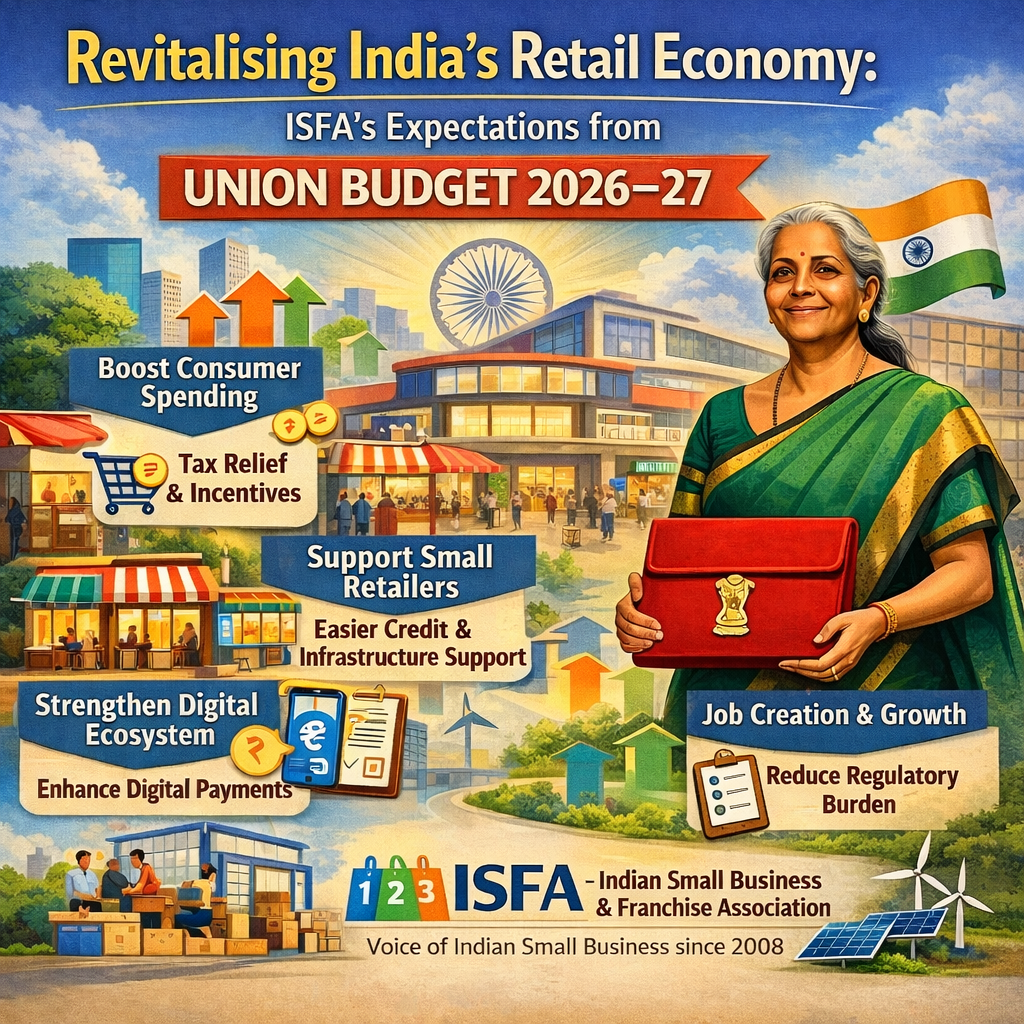
Revitalising India’s Retail Economy: ISFA’s Expectations from Union Budget 2026–27
As India heads into a pivotal year of economic transformation, the retail sector—especially small businesses and franchise networks—stands as a cornerstone of employment, innovation, and consumer engagement. With the Union Budget 2026-27 just around the corner, the Indian Small Business & Franchise Association (ISFA) presents a set of focused, pragmatic expectations for policy measures that can catalyze inclusive growth, strengthen grassroots commerce, and deepen India’s stature as a global retail powerhouse.
1. Strengthening Small Retail Businesses with Tailored Tax Reliefs
Small retailers and neighborhood businesses constitute the backbone of India’s consumption ecosystem. Given rising operational costs and evolving market dynamics, ISFA recommends:
- • Extend the GST composition scheme benefits by raising turnover thresholds and simplifying compliance further for micro and small retailers to reduce tax burden and ease of doing business.
- • Rationalize tax slabs for small retailers in high-inflation categories like apparel, electronics, and groceries.
- • Introduce targeted tax credits for digitization and adoption of digital payment systems to enhance competitiveness.
Such measures will significantly improve liquidity and profitability for small retail enterprises across India.
2. Boost to Working Capital & Access to Affordable Credit
Access to timely and affordable credit remains a perennial challenge for small retail outfits and franchise partners. ISFA urges the Finance Minister to:
- • Expand priority sector lending targets specifically earmarked for retail micro-enterprises under simplified documentation norms.
- • Launch subsidized interest rate schemes or guarantee-backed loans for retailers embracing technology, especially in Tier II-III markets.
- • Create a specialized Retail Resilience Fund under SIDBI (Small Industries Development Bank of India) to support recovery and expansion.
Greater credit availability will empower retailers to manage inventory cycles better and scale operations effectively.
3. Incentivizing Digital Transformation and Technology Adoption
Modern retail is increasingly driven by data, technology, and seamless customer experiences. To accelerate digital transformation, ISFA proposes:
- • Capital subsidies or depreciation allowances for small retailers investing in POS systems, e-commerce integration, cloud infrastructure and analytics tools.
- • Tax-deductible expenses for technology upgrades, cybersecurity enhancements, and staff digital-skills training initiatives.
- • Expansion of Digital Public Infrastructure (DPI) initiatives to retail micro-entrepreneurs through training and access support.
Bridging the digital divide will ensure Indian retail remains competitive domestically and globally.
4. Infrastructure & Logistics Support for Efficient Supply Chains
The efficiency of retail supply chains directly impacts pricing, quality, and competitiveness. To build robust supply and distribution networks, ISFA recommends:
- • Increased budgetary allocation for cold-chain infrastructure in hinterland clusters to reduce waste and support perishables trade.
- • Rationalization of logistics costs by expanding freight corridors and technology-enabled logistics hubs closer to retail clusters.
- • Tax incentives for shared logistics models that allow micro-retailers to pool deliveries and reduce costs.
Such interventions will enable retailers to serve customers more efficiently and sustainably.
5. Skilled Workforce Development and Formalization Support
Retail is one of India’s largest employers. Upskilling the workforce enhances productivity and supports formalization. ISFA appeals for:
- • Incentivized apprenticeship schemes tailored for retail sales, inventory management, and customer engagement.
- • Tax rebates for enterprises training local youth, especially women and underrepresented groups.
- • Simplified compliance frameworks for franchise employers to encourage formal employment contracts and social security benefits.
Investing in human capital is investing in India’s future prosperity.
6. Consumer Protection & Fair Market Practices
Fair trade, transparent pricing, and consumer trust are the pillars of sustainable retail growth. ISFA urges:
- • Clear guidelines to curb predatory pricing and anti-competitive practices that disadvantage small retailers.
- • Strengthened e-commerce regulation to ensure parity between digital marketplaces and brick-and-mortar businesses.
- • Consumer education campaigns jointly supported by the Government and industry bodies to promote informed and safe retail buying.
Protecting both businesses and consumers will foster a vibrant, equitable marketplace.
Conclusion
The retail sector stands at a transformative juncture—poised to benefit from India’s economic momentum while facing competitive, technological, and structural challenges. The upcoming Union Budget 2026-27 offers a strategic opportunity to reinforce policy support for small retailers, franchise networks, and allied stakeholders who are integral to India’s growth story.
By prioritizing tax rationalization, credit access, digital transformation, infrastructure, skill development, and fair trade practices, the Hon’ble Union Finance Minister can unleash the full potential of India’s retail ecosystem and ensure that prosperity reaches every corner of the nation.
The Indian Small Business & Franchise Association (ISFA) looks forward to a forward-looking, inclusive, and transformative budget that champions India’s retail entrepreneurs and strengthens the competitive fabric of our economy.
Interested in becoming a member? Apply Now!